A self-imposed game jam
Real game jams rarely fit my life (wrong weekend, too long, conflicts). So I'm setting my own: 16 hours, one theme, one game in Godot, shipped on Itch.
Contents
I love game jams. The rush, the vibes, the struggle against time and scope. But I also have a family, friends, my own business, I like to run, and a million other things I like to spend my time on. That means I rarely have the time a game jam needs. So, I’m setting my own.
I was inspired by Mathijs Koning (RoyallyScrewed on Itch) when he gave a talk at GodotCon 2026 in Amsterdam that stuck. He set himself a challenge to make 12 games in 12 weeks, for his final major project. Most of the rules come from his, or are inspired by them. Now, due to life, I don’t want to commit to one game a week, but a game in 16 hours is something I can get behind.
The rules
There are six hard constraints I will need to stick to:
- I can spend 16 hours total. I’ll track it manually and I can split it amongst as many days and weeks as life makes me. Spend more than 16 hours? Then I’ve failed the challenge.
- All fresh. It’s an empty Godot project. No boilerplate project, no carry-over code. No using external assets, with two exceptions: fonts and sound generation (without AI).
- The theme will be decided by a game jam theme generator. I don’t allow myself any rerolls, and I’ll only roll the theme when I know I have some time to brainstorm and ideate.
- Done means it’s up on Itch and playable.
- Engine: Godot. (Does that surprise you?)
- No AI, full stop. Not for brainstorming, not for coding, not for art, not for copy.
How I’ll spend the 16 hours
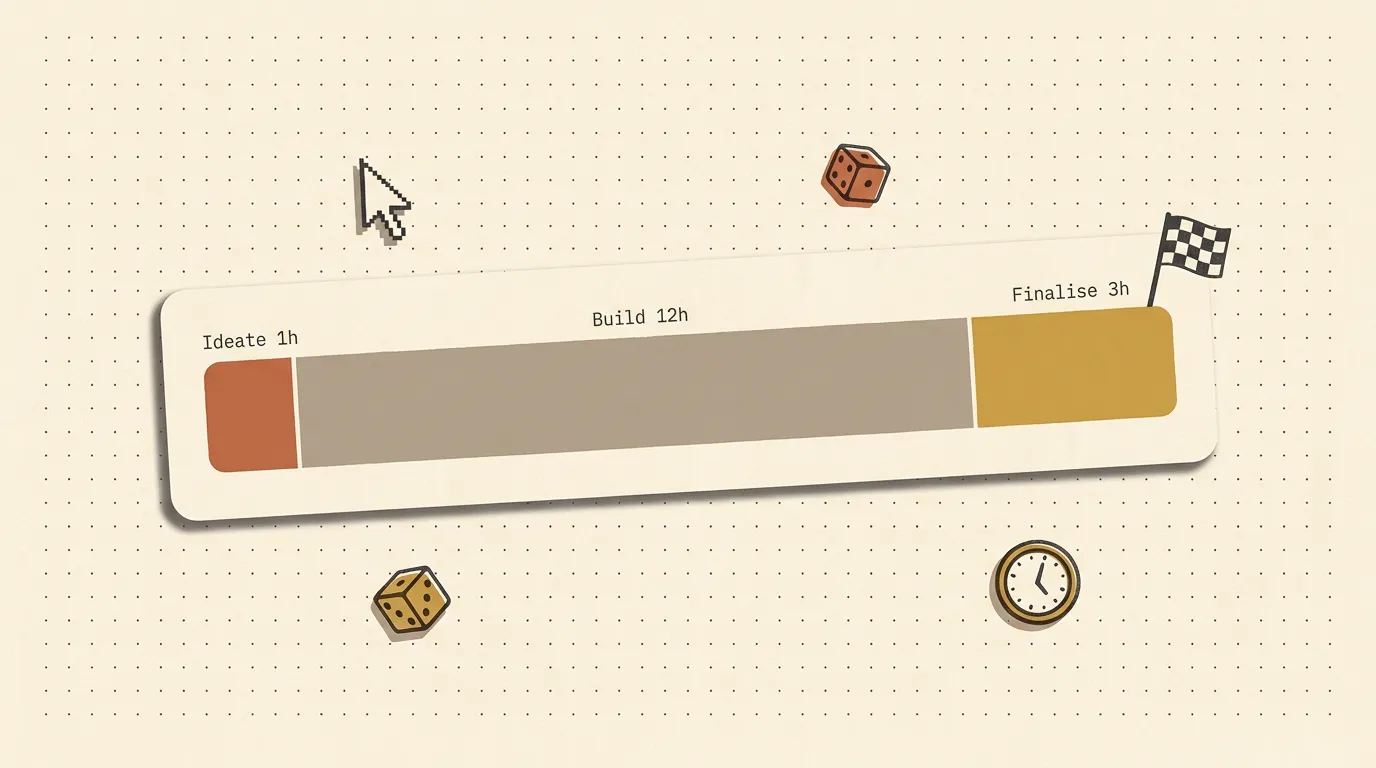
Here’s how I roughly think I’ll spend my time. 1 hour max for ideation and brainstorming. It’ll be tough to try and scope super small, as ideas come naturally, but scoping is harder. I’ll give myself 12 hours to build. I’ll focus on a vertical slice, and try to expand from there. The last 3 hours are for polish and shipping. Title screens, sounds, cover image, Itch page, export and upload. Something I learned from the postmortem of my last game (which you can read here, by the way). I’m still in doubt whether I should get playtesters in halfway through, but I guess I’ll figure that out during the jam.
Why these rules
16 hours
Astrofix, my last game, initially started as a super small challenge to make a game in an evening. Because I liked it, I put in a lot more time afterwards. Contrary to popular belief, restrictions make you more creative. This is why game jams are so enjoyable. They restrict you with a theme and time. It needs to hit that balance: tight enough to bite, but not so tight you can’t ship. Mathijs Koning decided on 16 hours to limit himself and prevent him from burning out in a week, and I simply followed suit.
All fresh
It’s about honesty really. If I set myself a challenge to make a game in 16 hours, but I can reuse components, scenes, scripts, and whatnot that I spent more time on in the past, that feels like cheating to me. I want to be able to honestly say I made it in 16 hours. Will it be good? Probably not, but it’ll be honest (and more importantly, fun to do).
Theme and no rerolls
Same here. Restricting myself is the point. I don’t want to be able to think of certain concepts, mechanics, or things I’d like to include beforehand. In my book, that’s cheating. Rerolling a theme until you get one you like is the same as picking a theme.
Definition of done
This’ll be the hardest. There’s always more to do, more to add, to improve. But the time is the biggest restriction, and there’s always plenty of stories of game jam participants who had issues at the end preventing them from submitting. The 16-hour version is the one that ships.
No AI
I’m not going to lie here. I like using AI. It’s got its flaws, ethical concerns, and other issues, but it has allowed me to do amazing things professionally, that I otherwise would’ve never been able to do. That being said, this is about learning, about having fun, about feeling uncomfortable and enjoying it. Plus, let’s say I vibecoded a game in 16 hours, did I really make it? It all falls back to honesty, again.
The practice around it
The rules cover what I need to stick to during the jam. I’ve covered how I intend to spend the 16 hours, but this bit is about the doing. I’ll manually keep track of the time spent on the project. After every session, I’ll write down notes about what I did, things I ran into, how I fixed them, and where I intend to go from there. Once completed, I’ll bundle those notes into a postmortem, so no posts about the game while it’s in progress. A thread or two might appear on the Godot Forum if I need help, but no “follow along” posts mid-jam.
What it isn’t
This is not an intended replacement for a real game jam. I still want to do some of those this year, if only my calendar allows it. It’s intended as a fun challenge that suits my life. If life requires me elsewhere for the whole weekend? So be it. It also isn’t me plus AI. Like I said, I use AI a lot during my work. I like it, but I also miss working on things myself. This is that. Just me, a keyboard, and an idea.
Next up
I hope to finish this game within a few weeks. As mentioned, I’ll treat it as a game jam game. With an Itch page, a postmortem, and a project page here. With all that being said, I’m pretty damn sure I’ll also overscope on this one.